Moog Subharmonicon Semi-Modular Analog Polyrhythmic Synthesizer
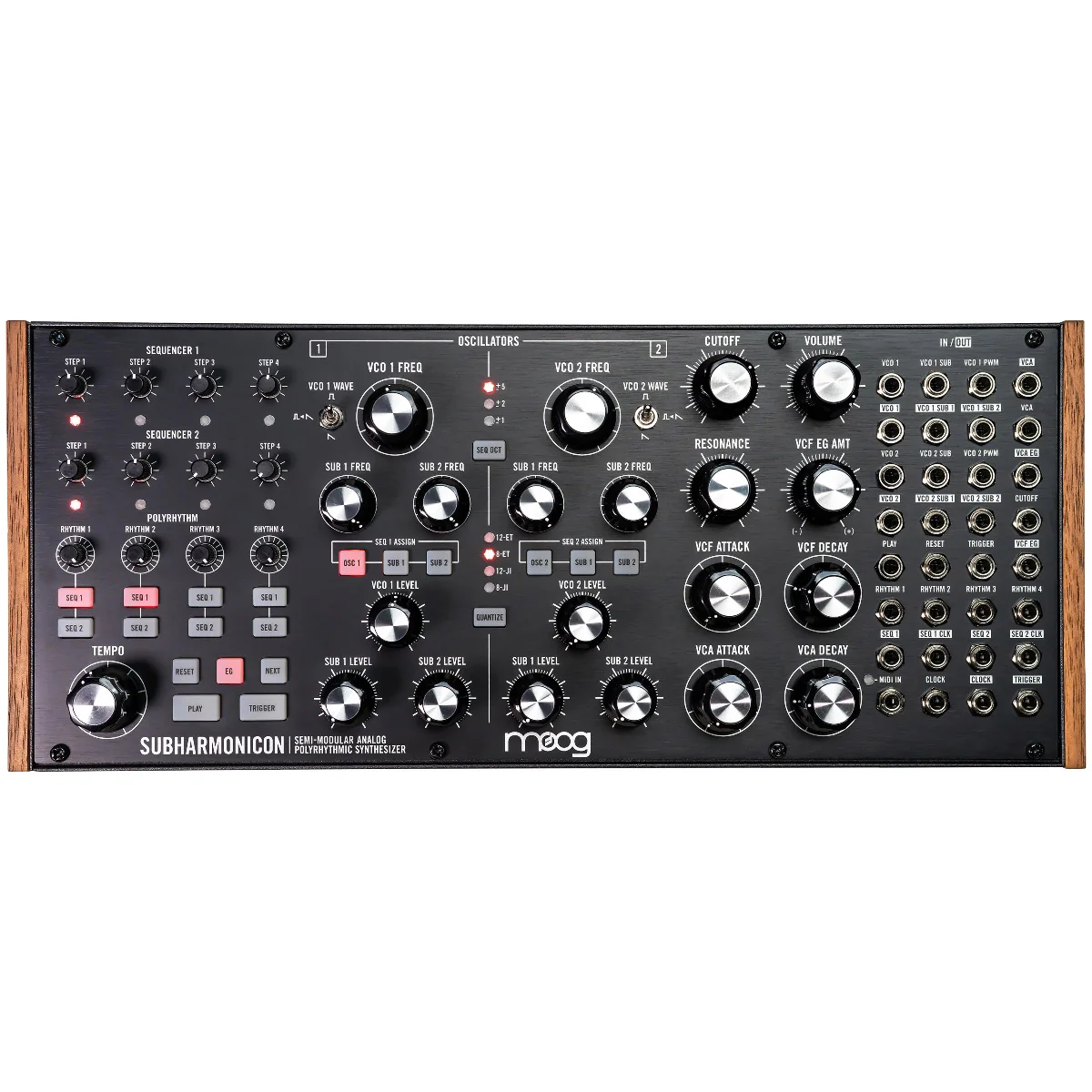
Moog Subharmonicon is a semi-modular polyrhythmic analog synthesizer that employs a 6-tone sound engine and multi-layered sequencers to explore the world of subharmonics, polyrhythms and the unique relationships they create.

VCOs and subharmonic oscillators
Subharmonicon's characteristic sound starts with two analog VCOs and four subharmonic oscillators for a total of six powerful sound sources. Each subharmonic tone is mathematically derived from one of the two main VCOs, giving the resulting chord shapes a beautifully coherent quality.

Quantize notes to scale
Onboard quantization lets you dial in perfect intervals every time with selections for multiple tuning systems. Choose from contemporary equal temperament settings, the heavenly intervals of just intonation or the unlimited freedom of no quantization at all.

Sequencers and rhythm generators
Animating Subharmonicon's distinctive chord shapes is done through a polyrhythmic pair of 4-step sequencers. Each sequencer is clocked by any or all of four rhythm generators that output mathematical divisions of the master tempo. Layer multiple rhythm generators on top of each other to create complex polyrhythms and discover inspiring new patterns and styles.

Envelope generators and Moog ladder filter
Delve into Subharmonicon's dual envelope generators, Moog ladder filter and analog VCA to call up dynamic articulations ranging from lush pads and blurred edges to percussive plosives and ritualistic rhythms.

Semi-modular patch bay
Although no patching is required to start creating, exploring Subharmonicon's modular patchbay unlocks worlds of possibilities as you make novel connections and plug into new ideas. The 32-point 1/8" patchbay can be patched into itself, expanding Subharmonicon's onboard capabilities, or interfaced with Mother-32, DFAM and other external eurorack-compatible gear. Use Subharmonicon as a standalone synth with the included power supply or simply remove the front panel to install into any eurorack system.

Experimental origins
Subharmonicon is inspired by Joseph Schillinger's mathematical system for musical composition and is influenced by two analog innovations from the 1930s and 1940s: Mixtur-Trautonium, which employed a series of subharmonic oscillators to generate electronic undertones, and Rhythmicon, an instrument developed by Leon Theremin capable of sounding multiple harmonically related polyrhythm generators simultaneously.

Mixtur-Trautonium and Rhythmicon
Mixtur-Trautonium created subharmonics by dividing the frequency of its primary oscillator, while Rhythmicon created polyrhythms that were multiplications of its primary tempo. These concepts of subharmonics and polyrhythms form the historic roots of Moog Subharmonicon.

Undertone series
The undertone series, or subharmonic series, results from the division of an initial fundamental frequency (f) by successive integer values (unlike the overtone series, which results from integer multiples of the fundamental frequency). Where overtones are found to occur naturally in acoustic sounds, undertones must be produced through more extreme or novel methods, such as electronic circuitry.

Polyrhythms
Polyrhythms employ multiple rhythms playing at once to create complex, interweaving phrases. In the same way that a subharmonic oscillator divides the fundamental frequency to create a musically related subharmonic, each rhythm generator in Subharmonicon uses an integer value to divide the current tempo value to create a new rhythm.



Description
Moog Subharmonicon is a semi-modular polyrhythmic analog synthesizer that employs a 6-tone sound engine and multi-layered sequencers to explore the world of subharmonics, polyrhythms and the unique relationships they create.
VCOs and subharmonic oscillators
Subharmonicon's characteristic sound starts with two analog VCOs and four subharmonic oscillators for a total of six powerful sound sources. Each subharmonic tone is mathematically derived from one of the two main VCOs, giving the resulting chord shapes a beautifully coherent quality.
Quantize notes to scale
Onboard quantization lets you dial in perfect intervals every time with selections for multiple tuning systems. Choose from contemporary equal temperament settings, the heavenly intervals of just intonation or the unlimited freedom of no quantization at all.
Sequencers and rhythm generators
Animating Subharmonicon's distinctive chord shapes is done through a polyrhythmic pair of 4-step sequencers. Each sequencer is clocked by any or all of four rhythm generators that output mathematical divisions of the master tempo. Layer multiple rhythm generators on top of each other to create complex polyrhythms and discover inspiring new patterns and styles.
Envelope generators and Moog ladder filter
Delve into Subharmonicon's dual envelope generators, Moog ladder filter and analog VCA to call up dynamic articulations ranging from lush pads and blurred edges to percussive plosives and ritualistic rhythms.
Semi-modular patch bay
Although no patching is required to start creating, exploring Subharmonicon's modular patchbay unlocks worlds of possibilities as you make novel connections and plug into new ideas. The 32-point 1/8" patchbay can be patched into itself, expanding Subharmonicon's onboard capabilities, or interfaced with Mother-32, DFAM and other external eurorack-compatible gear. Use Subharmonicon as a standalone synth with the included power supply or simply remove the front panel to install into any eurorack system.
Experimental origins
Subharmonicon is inspired by Joseph Schillinger's mathematical system for musical composition and is influenced by two analog innovations from the 1930s and 1940s: Mixtur-Trautonium, which employed a series of subharmonic oscillators to generate electronic undertones, and Rhythmicon, an instrument developed by Leon Theremin capable of sounding multiple harmonically related polyrhythm generators simultaneously.
Mixtur-Trautonium and Rhythmicon
Mixtur-Trautonium created subharmonics by dividing the frequency of its primary oscillator, while Rhythmicon created polyrhythms that were multiplications of its primary tempo. These concepts of subharmonics and polyrhythms form the historic roots of Moog Subharmonicon.
Undertone series
The undertone series, or subharmonic series, results from the division of an initial fundamental frequency (f) by successive integer values (unlike the overtone series, which results from integer multiples of the fundamental frequency). Where overtones are found to occur naturally in acoustic sounds, undertones must be produced through more extreme or novel methods, such as electronic circuitry.
Polyrhythms
Polyrhythms employ multiple rhythms playing at once to create complex, interweaving phrases. In the same way that a subharmonic oscillator divides the fundamental frequency to create a musically related subharmonic, each rhythm generator in Subharmonicon uses an integer value to divide the current tempo value to create a new rhythm.